761 St Andrews Blvd, Charleston, SC 29407
 (843) 873-6004
 Text Us


Blog
The Viral Spoon Trick for Plantar Fasciitis: Why Foot Pain Sometimes Needs More Than Stretching
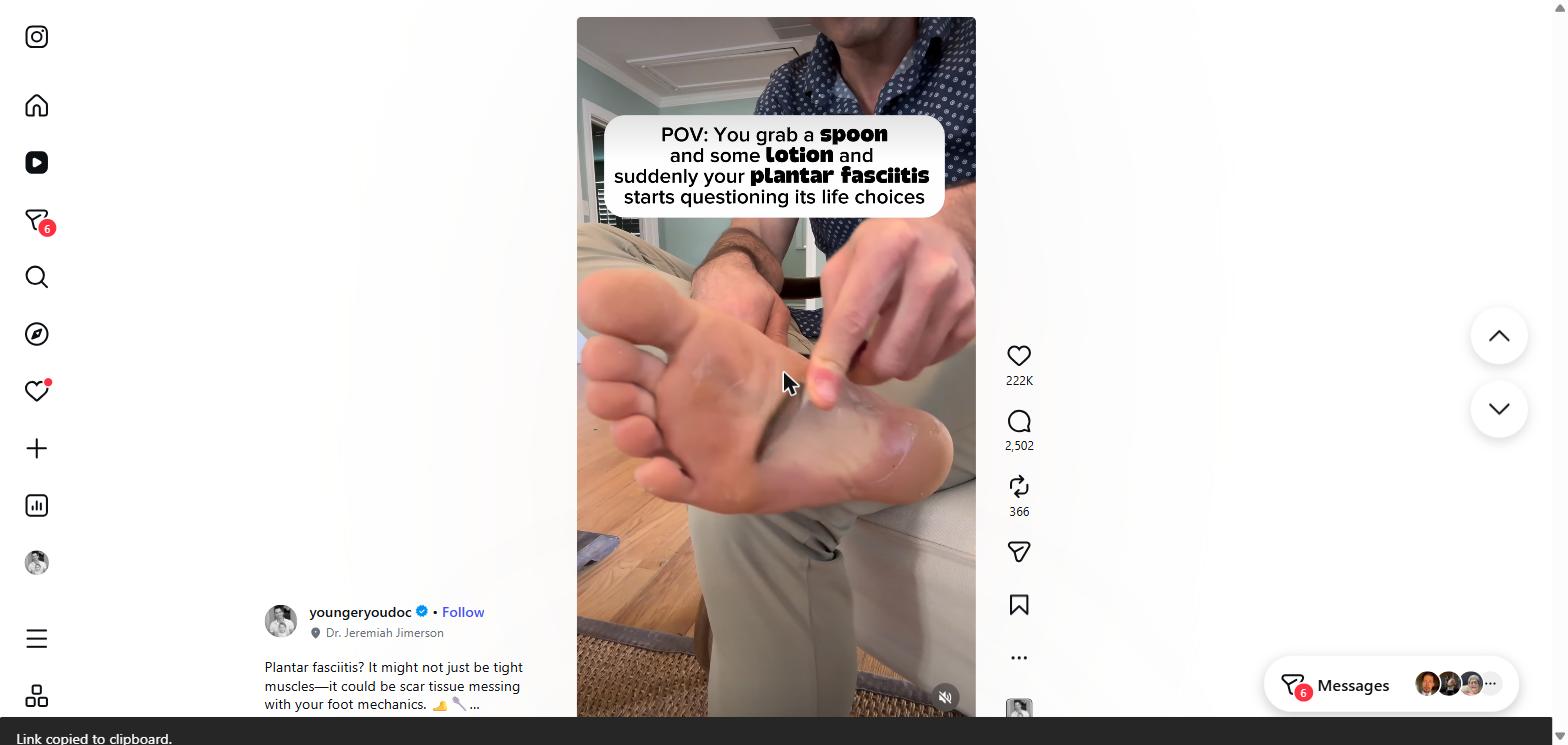
If you saw me using coconut oil and a spoon on the bottom of someone's foot and thought, "There is no way this is a real thing," you were not alone.
That video ended up getting over 100 million views around the world, and the comments were hilarious.
Some people were amazed that something so simple could help foot pain. Some people said their chiropractor, physical therapist, or massage therapist had done a similar technique in the office. And some people just could not get past the fact that I was using a spoon.
But here's the thing: using a rounded tool on the skin and fascia is not new.
This is a simple form of instrument-assisted soft tissue work, often called IASTM. Similar scraping techniques have been used for thousands of years in Eastern medicine, commonly known as gua sha. Traditionally, people used tools like buffalo horn, coins, jade tools, or even household objects with a smooth rounded edge.
So yes… a spoon can work. The point is not the spoon. The point is the input.
Why Plantar Fasciitis Hurts So Much in the Morning
Plantar fasciitis is one of the most frustrating foot problems because it often feels worst when you first stand up after sleeping or sitting.
A lot of people describe it as a sharp, stabbing pain in the heel or arch when they take their first few steps in the morning. Then after walking around for a bit, it may loosen up and feel a little better.
That pattern is a big clue.
Think of the muscles and fascia on the bottom of the foot like stretchy rubber bands. They are supposed to glide, stretch, and absorb force as you walk.
But when that tissue gets irritated, overloaded, thickened, or stuck down, it can start behaving less like a smooth rubber band and more like a rubber band with staples in it.
During the night, or after you have been resting for a while, that tissue cools down and stiffens up. Then when you suddenly stand and walk again, the tight irritated area gets yanked on.
That is why those first few steps can feel brutal.
It is not always that the foot is "broken." A lot of the time, the tissue is irritated, guarded, sticky, and not tolerating load well.
What the Spoon Technique Is Trying to Do
In the viral video, I used coconut oil and a spoon to work the bottom of the foot. The goal is not to beat the foot into submission.
If you are trying to murder your foot with a spoon, you are doing this wrong.
The sensation should feel like "hurts so good" or "that feels like it needs to happen." It should not feel sharp, scary, bruising, or unbearable.
This type of instrument-assisted work may help by:
- Stimulating blood flow to the area
- Improving the glide of the skin, fascia, and underlying tissue
- Giving the nervous system new sensory input
- Helping calm protective guarding
- Working through areas that feel thick, gritty, or restricted
- Encouraging the foot to tolerate movement and pressure better
In practice, I rarely think of plantar fasciitis as only a bottom-of-the-foot problem. Yes, the painful area may be in the heel or arch. But the tension chain often continues up the calf, behind the knee, into the hamstrings, and sometimes even higher.
That is why in the office, we may work the bottom of the foot, the heel, the Achilles area, the calf, and sometimes up into the hamstring depending on what the person’s body is showing us.
The foot is usually where people feel the pain. It is not always the only place creating the problem.
How to Try the Spoon Technique at Home
This is one reason the video spread so fast. It is simple enough for people to try at home.
You do not need a fancy tool. You can use a smooth soup spoon and a small amount of coconut oil, lotion, or massage oil.
Start gently. Work along the bottom of the foot, especially through the arch and the areas that feel tight, ropy, or tender. Use slow strokes. You can go from the heel toward the toes, from the arch toward the heel, or across the tight bands.
You are looking for that productive "good hurt" sensation — not bruising, not stabbing, not punishment, and not "I saw a guy on the internet do this and now I’m going to destroy my foot."
A good starting point is 1–2 minutes, then stand up and see how the foot feels. You can always do more later. You do not have to win the spoon Olympics on day one.
Avoid doing this over open wounds, skin infections, severe swelling, unexplained bruising, numbness, or areas where you cannot feel normal sensation. If you are on blood thinners, have significant neuropathy, or have a medical condition that affects healing or circulation, get professional guidance first.
Why Stretching Alone Often Fails
Most people with plantar fasciitis have already tried stretching. Sometimes it helps. Sometimes it does almost nothing.
That is because plantar fasciitis is not always just a "tight foot" problem. It may involve irritated fascia, poor ankle mechanics, calf tension, weakness in the foot, altered gait, nerve irritation, or a tissue-healing issue that has been building for months or years.
If the tissue is angry and overloaded, stretching it harder is not always the answer. Sometimes it needs better blood flow. Sometimes it needs better glide. Sometimes it needs load management. Sometimes it needs foot and calf strength. Sometimes it needs the calf, ankle, hip, and walking pattern evaluated. And sometimes, especially in stubborn chronic cases, it needs more advanced treatment.
How We Treat Stubborn Plantar Fasciitis in Charleston
At Fix Your Pain in Charleston, I look at plantar fasciitis differently than just "rub the bottom of the foot and hope."
When someone comes in with stubborn heel pain or arch pain, I want to know why it keeps coming back. We may look at:
- The plantar fascia and bottom of the foot
- Calf and Achilles tension
- Ankle mobility
- Foot strength and control
- Hip mechanics
- Walking and loading patterns
- Nerve irritation
- Areas of thickened, tender, or restricted soft tissue
Treatment may include hands-on fascia work, Active Release Techniques, instrument-assisted soft tissue work, chiropractic care, mobility homework, strengthening, and in more stubborn cases, SoftWave Therapy.
SoftWave Therapy is one of the tools we use for chronic plantar fasciitis when the tissue needs a stronger healing stimulus. It helps stimulate blood flow, calm inflammation, and support a regenerative healing response in the area for weeks after treatment.
The spoon trick can be a great at-home tool. But if your foot pain keeps coming back, if every morning feels like stepping on a knife, or if you have been stretching for months without real progress, it may be time to look deeper.
When to Get Help for Plantar Fasciitis
You should consider getting evaluated if:
- Your heel pain has lasted more than a few weeks
- The first steps in the morning are consistently painful
- Stretching only gives temporary relief
- The pain keeps returning when you walk, run, golf, play pickleball, or work out
- You feel pain in the heel, arch, Achilles, or calf
- You are starting to limp or change how you walk
- You have already tried shoes, inserts, stretching, or massage and still feel stuck
Plantar fasciitis can become stubborn when it is treated too simplistically. Sometimes the foot needs more than another stretch. Sometimes it needs the right input, the right treatment, and a plan that actually matches what is happening in your body.
If you are in Charleston, SC and your plantar fasciitis or foot pain keeps coming back, you can book a visit with Dr. Jeremiah Jimerson at Fix Your Pain.
We will look at the foot, the calf, the fascia, the mechanics, and the bigger picture — and figure out why your foot keeps yelling at you every morning.
Because yes, a spoon can help. But if you need the whole toolbox, that is what we do every day.
Related from my practice in West Ashley, Charleston:
Plantar fasciitis & foot pain · Knee pain · West Ashley chiropractor
‹ Back
Recent Posts
-
-
-

-
-
Why Hip Bursitis Is Really Your Body’s Warning Light
January 5, 2026
 Book Your Appointment
  Call Us Now (843) 873-6004