761 St Andrews Blvd, Charleston, SC 29407
 (843) 873-6004
 Text Us


Blog
Does the Spoon Trick for Plantar Fasciitis Actually Work? The Doctor Behind the Viral Video Explains
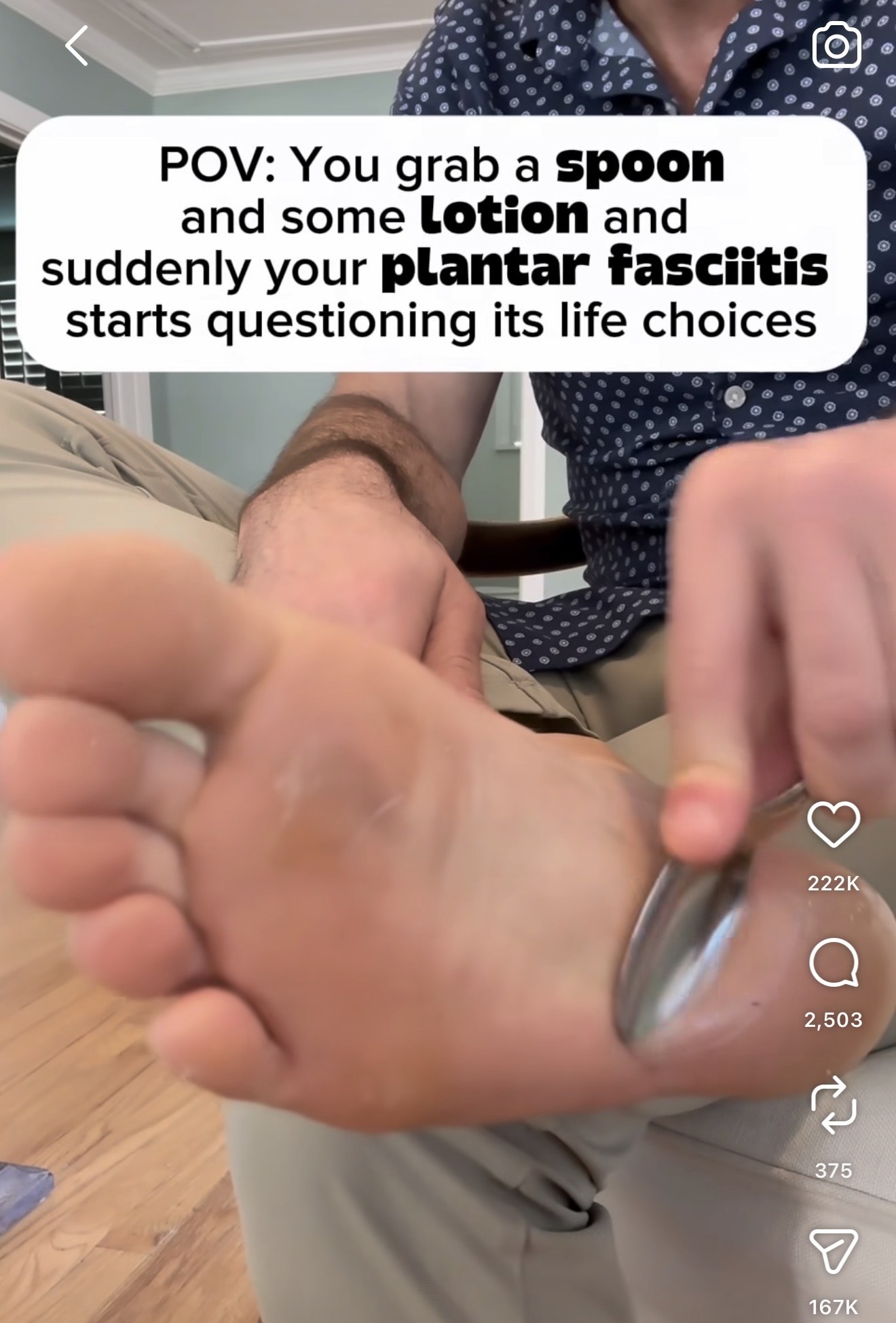
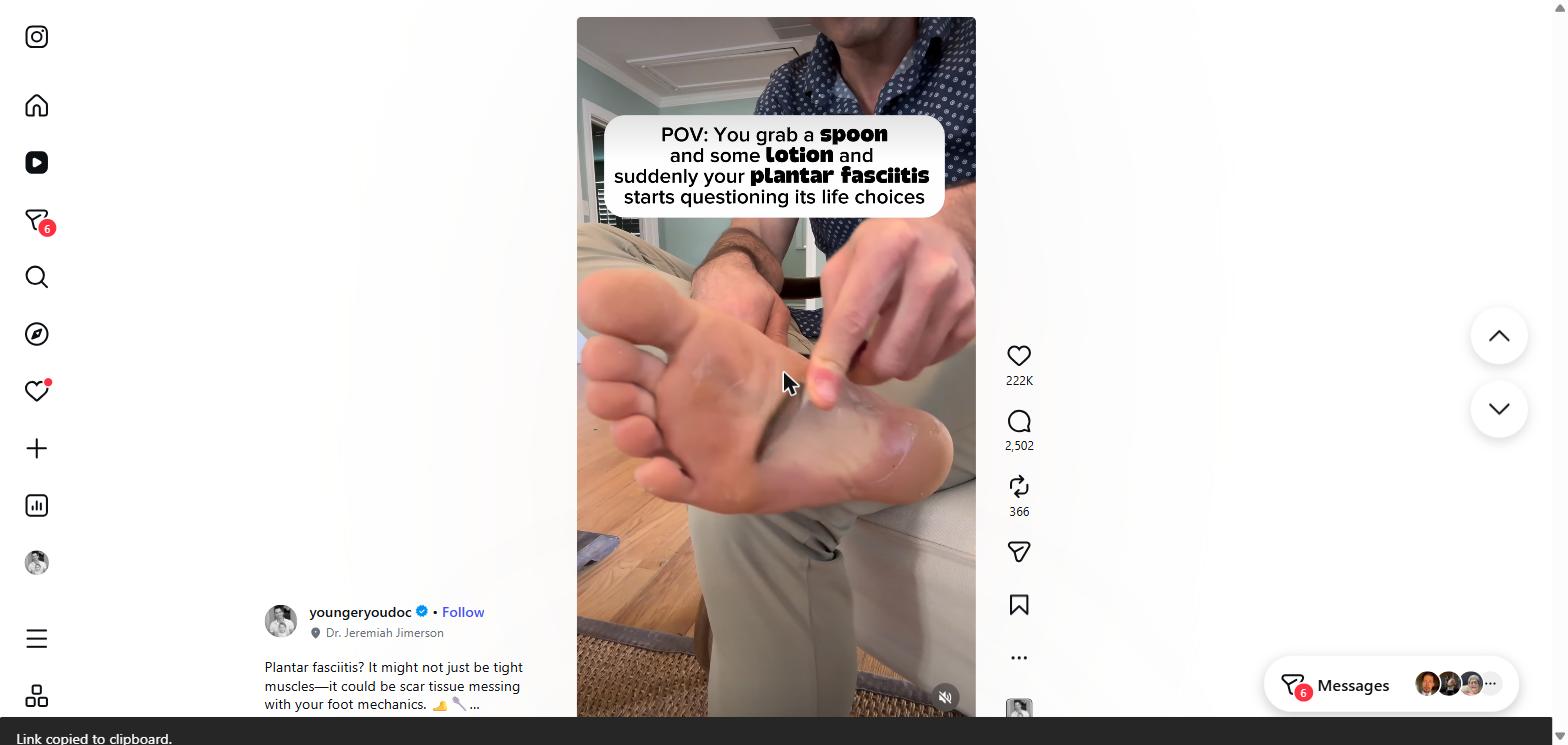
Yes — for many people, scraping the bottom of the foot with a spoon genuinely helps plantar fasciitis, and it isn't a TikTok gimmick. It's a westernized version of Gua Sha, a Chinese technique that has used household objects for myofascial scraping for thousands of years. I'm Dr. Jeremiah Jimerson, a chiropractor in Charleston, SC, and I'm the one in the video you probably saw — it's been viewed over 100 million times on Instagram alone and spawned thousands of copycats. Here's what's actually happening to your foot, how to do it correctly, and when a spoon won't be enough.
Watch the original video on Instagram (@youngeryoudoc)
What the spoon is actually doing
Plantar fasciitis often gets treated as if it's purely a tightness problem — stretch your calves, roll a frozen water bottle, buy new inserts. Sometimes that works. But in many of the stubborn cases I see in my office, the real culprit is scar tissue and fascial adhesions interfering with your foot mechanics.
Your plantar fascia is a thick band of connective tissue that takes a beating with every step. When it gets irritated and micro-damaged over months or years, the body lays down disorganized repair tissue. Those sticky adhesions restrict how the fascia glides, which changes how your foot loads — and that keeps the irritation cycle going no matter how much you stretch.
Scraping the tissue with a smooth, hard edge — a spoon, in this case, with a little lotion so it glides — applies focused shear force that stretching can't. The goal is to break up those adhesions, stimulate local blood flow, and give the tissue a reason to remodel in a more organized way. Improved glide, improved mechanics, less pain.
This technique is thousands of years old
Whenever this video goes viral again, my answer in the comments is the same: this is Gua Sha. Chinese practitioners have been using smooth household tools — spoons, coins, jar lids — for myofascial scraping for thousands of years.
What you may know as the Graston Technique or IASTM (Instrument-Assisted Soft Tissue Mobilization) is essentially the westernized, instrument-branded descendant of that same idea. Here's the part that should make you smile: those precision-machined stainless steel Graston tool sets used to cost practitioners thousands of dollars. In clinics, we pair those tools with an actual diagnosis of which tissue is involved — but the underlying principle, using a smooth edge to mobilize soft tissue, did not start in an American clinic. It started in Chinese households millennia ago, with whatever was in the drawer.
That's also why the spoon version works at all: the tool was never the magic. The mechanics are. A $3,000 instrument and a kitchen spoon apply the same basic shear force to the tissue.
How to do the spoon technique at home
- Pick the right spoon. Look for one with a slightly rounded edge — you want smooth glide, not a sharp lip digging into the skin.
- Use a little bit of oil or lotion. Coconut oil, body lotion — anything slick. A small amount is all you need. The glide matters; don't scrape dry skin.
- Sit with your ankle crossed over your knee so you can reach the sole of your foot comfortably.
- Use the edge of the spoon's bowl and scrape along the arch with firm, slow strokes — from heel toward the ball of the foot.
- Listen for the gravelly sound. It's completely normal to hear (and feel) a gravelly scraping noise as the spoon glides over scar tissue and adhesions — that texture is exactly what you're working on. Healthy tissue feels and sounds smooth.
- Work for a few minutes per foot. You're looking for pressure and mild "gritty" discomfort over the tender spots — not sharp pain.
- Expect some redness. That's the point (it's literally what "sha" refers to in Gua Sha). Bruising, sharp pain, or numbness means stop.
- Be consistent. A few minutes daily for a couple of weeks beats one aggressive session.
One of the top comments on the video sums up what I hear in my office: "It works! I was suffering for months, and by doing this for 10 minutes I felt such relief."
When the spoon won't be enough
I'll be straight with you, because this is the part the copycat videos leave out: the spoon helps the tissue, but it doesn't answer why your fascia broke down in the first place.
If your plantar fasciitis keeps coming back, the driver is usually upstream — how your ankle moves, how your hips load, how your gait distributes force. Scraping the sole treats the symptom site. If the mechanics that created the problem don't change, the adhesions come back.
See a professional instead of self-treating if:
- Pain persists after 2–3 weeks of consistent self-treatment
- You have sharp, stabbing heel pain first thing in the morning that isn't improving
- There's numbness or tingling (that's a nerve pattern, not fascia)
- You have diabetes, neuropathy, thin skin, or take blood thinners — scraping isn't appropriate without guidance
In my Charleston office, stubborn cases usually get a combination of instrument-assisted soft tissue work, Active Release Technique for the calf and foot chain, and — for chronic tissue that won't remodel — SoftWave therapy to stimulate healing at the cellular level. The spoon is the free version of step one. It is not the whole plan.
Frequently asked questions
How long until the spoon technique works?
Many people feel looser after one session, but meaningful change in chronic cases typically takes 1–3 weeks of daily consistency. If nothing changes by week three, the problem likely isn't superficial adhesions.
Is Gua Sha the same as the Graston Technique?
Same core principle — instrument-assisted soft tissue mobilization. Graston/IASTM is the modern clinical formalization with machined tools and specific protocols; Gua Sha is the traditional practice it descends from.
How hard should I scrape?
Firm enough to feel pressure and mild discomfort over tender spots; never sharp pain. Redness is normal and expected. Deep bruising means you went too hard.
Why a spoon instead of a proper tool?
Because it's in your kitchen. The mechanics of a smooth, hard edge are what matter. Clinical tools give a practitioner better precision and feedback, but for basic self-treatment, the spoon does the job — which is exactly why the Chinese used household objects for thousands of years.
Dr. Jeremiah Jimerson, DC, ART is a soft-tissue specialist chiropractor in Charleston, SC. His pain-relief videos as @youngeryoudoc have been viewed hundreds of millions of times. If your foot pain isn't responding to self-treatment, schedule an appointment or call (843) 873-6004.
‹ Back
Recent Posts
-
-
-

-
-
Why Hip Bursitis Is Really Your Body’s Warning Light
January 5, 2026
 Book Your Appointment
  Call Us Now (843) 873-6004